Skip to content

Melanie Walker

Dr. Melanie Walker is a prominent South African scholar who has been working as Professor of Higher Education Studies at the  University of Nottingham in the UK, where she been Director of Postgraduate Students and a Director of Research in the Faculty of Social Sciences. She will join the University of the Free State in February 2012 as Senior University Professor in the Postgraduate School. She is currently Director of Research Training and a senior researcher in the EU-funded Marie Curie EDUWEL project, which includes senior researchers from eight European countries and 15 early-stage researchers.

With a long-standing commitment to social-justice research and equality practices, she is currently widely recognized internationally as leading in the application of the capability approach and human development to higher education policy and practice.
Susan Wright

Dr. Susan Wright is professor of  Educational Anthropology – Department of Education at at Aarhus University – Denmark. Her research interests focus on Internationalization and Globalization of Higher Education.  

Latest Publications

2012 (co-authors Rebecca Boden and Penelope Ciancanelli) ‘Trust Universities? Governance for Post‑Capitalist Futures’ Journal of Co-operative Studies 45(2): 16-24.

2012 ‘Ranking universities within a globalised world of competition states: to what purpose, and with what implications for students?’ in Hanne Leth Andersen & Jens Christian Jacobsen (eds) Uddannelseskvalitet i det 21. Århundrede,  Frederiksberg: Samfundslitteratur, pp: 79-100.

2012  (co-author Jakob Williams Ørberg) ‘The double shuffle of university reform – the OECD/Denmark policy interface’ in Atle Nyhagen and Tor Halvorsen (eds) Academic identities – academic challenges? American and European experience of the transformation of higher education and research. Newcastle upon Tyne: Cambridge Scholar Press.

2011 (co-editors Cris Shore and Davide Peró) Policy Worlds: Anthropology and the Anatomy of Contemporary Power, EASA Series. Oxford: Berghahn.

2011 (co-author Sue Reinhold) ‘“Studying through”: a Strategy for Studying Political Transformations. Or Sex, Lies and British Politics’ in Cris Shore, Susan Wrightand Davide Peró (eds) Policy Worlds: Anthropology and the Anatomy of Contemporary Power, EASA Series. Oxford: Berghahn, pp. 86-104.

See more of her publications

See complete CV

Jessica Graybill

Dr. Jessica Graybill is an Assistant Professor in the Geography Department at Colgate University.  Her interdisciplinary pedagogy and research is in Urban Ecology, Urban Political Ecology, and Urban and Environmental Issues of the Former Soviet Union. Publications include The Rough Guide to Interdisciplinarity: Graduate Student Experiences (2006) and Continuity and Change: (Re)Constructing Geographies of the Environment in Late Soviet And Postsoviet Russia (2007).

See more

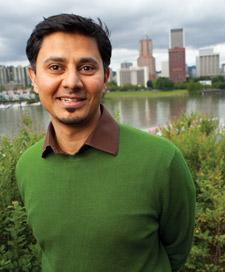
Vivek Shandas

Dr.  Vivek Shandas is an associate professor in the Nohad A. Toulan School of Urban Studies and Planning, and an associate researcher in the Center for Urban Studies at Portland State University.  He is  also the founder of the newly established Sustaining Urban Places Research Lab (SUPR Lab) which focuses on three substantive areas of investigation: (1) examining feedback between environmental change and human behavior; (2) developing community-based indicators for measuring the social and environmental conditions; and (3) characterizing the relationship between urban development patterns and environmental quality. His collaborative approach to research pursue to address pressing societal challenges.

See more

Beate Scholz

Dr Beate Scholz is director of Scholz – consulting training coaching. She has worked as strategy consultant, project facilitator and coach since 2003 (until April 2008 in addition to her position at the German Research Foundation, DFG). Her company focuses on supporting universities, research organizations and governments in designing, implementing and evaluating concepts and strategies for research career development and international research collaboration. Training and coaching of individual investigators and researchers’ teams in view of research career development issues and strategic acquisition of research funds completes the professional portfolio of Beate Scholz.

From 1997 until 2008 Beate Scholz worked for Germany’s central research funding organization, the DFG, where she headed the Research Career Strategy division, beginning in 2001. She was involved in developing Germany’s Excellence Initiative, namely the Graduate Schools Programme.

During her professional career Beate Scholz has conducted various surveys and evaluations, e.g. on behalf of the European Science Foundation’s European Alliance on Research Career Development, on the AFR Programme (funding outstanding PhD candidates and postdocs) of Luxembourg’s Fonds National de la Recherche in 2010 and on ‘Cross-border research collaboration in Europe’ on behalf of the European Heads of Research Councils and the European Science Foundation in 2009.

In addition, she has gained considerable experience as reviewer in selection panels for doctoral programmes and junior research groups on behalf of the German Helmholtz Association and two Irish Research Councils and in chairing the international management committee of the European Young Investigator Award. Moreover she is a member of the global network of experts ‘Forces & Forms of Change in Doctoral Education Worldwide’, based at the Center for Innovation and Research in Graduate Education at the University of Washington in Seattle, USA. She is a demanded expert by the European Commission, where she currently serves as member and rapporteur to the Expert Group on the Research Profession.

Beate Scholz holds a PhD in Modern Italian History from the University of Trier. She studied history, political sciences and international economics at the Universities of Trier, Reading/UK and Cologne and carried out research in Italy and Austria

See more

Director

Maresi Nerad is the founding director of the Center for Innovation and Research in Graduate Education (CIRGE) and Professor for Higher Education, in the Leadership in Higher Education Program, College of Education, at the University of Washington, Seattle.  

A native of Germany, Dr. Nerad received her doctorate in higher education from the University of California, Berkeley; directed research in the central Graduate Division of UC Berkeley for 15 years; spent 2000 as Dean in Residence at the Council of Graduate Schools, the professional Association of US Graduate Deans, in Washington, D.C; joined the University of Washington (UW) in Seattle in 2001, and opened CIRGE in 2002. 

Dr. Nerad has served on many national and institutional doctoral education reviews including the German Excellence Initiative (2006, 2011), the U.S. National Research Council (2002-3) to examine the Methodology for the Assessment of Research Doctorate Programs.  She served and still serves on US and international advisory boards, such as International Advisory Committee for Science and Engineering of the US National Science Foundation (NSF) (2011- 2013); the Presidential Innovation Broad of the University of Bremen, Germany (2014-19), the Graduate Academy of the Goethe University of Frankfurt (2011-16); and undertakes formative and summative research for flagship interdisciplinary doctoral programs of NSF (IGERT/NRT), the German Excellence Graduate Schools (Materials MAINZ), or the European Commission (UNIKE).

She has written and edited 5 books and published numerous articles on doctoral education.  The latest book appeared 2014, Globalization and it Impact on the Quality of the PhD, Sense Publishers, and received the outstanding publication award from the American Education Research Association (AERA) SIG 168 in 2015. 

See complete CV


CIRGE collaborated with the European Alliance on Research Careers Development

Organized by the European Science Foundation, CIRGE participated in the workshop entitled “How to track the researcher’s career” in Luxembourg, February 2012. The event highlighted the relevance of research career tracking in the European research agenda.

According to the main conclusions, knowing how researchers move in their careers will contribute to improve the quality of research, to understand the decision of researchers in their careers and to provide accountability to the tax-payers.

By following up with doctoral graduates, surveying them after graduation, and tracking studies, CIRGE assessed the suitability of funding, the quality of training and working conditions offered during the doctoral phase, and also explored the quality of doctoral training.

A major reason for carrying out career tracking studies is to provide the information on career movements and understand international and intersectoral mobility as well as employment patterns of researchers.

On the other hand, these studies indirectly measure impact which is an interesting source for the funders of doctoral education, in most cases, tax payers.

Dr. Maresi Nerad, key speaker in this workshop, asserted that career studies of masters and doctorates should be used with a broader purpose than for labor market concerns and to “focus on understanding the diverse developments of individual within intersections of their private lives, institutional and societal forces.”

In her opinion, these studies should also take into account the many attempts undertaken by national research funding agencies for innovative interdisciplinary programs with international involvements.

See final report

Review the site

What is the Future of Doctoral Education in the 21st Century?

Dr. Maresi Nerad (Director of CIRGE), Professor at the University of Washington, and Dr. Beate Scholz, (Scholz Consulting), both researchers of CIRGE, discussed the future of Doctoral Education during the European Science Open Forum in Dublin, July 2012.   The experts presented their visions for the science PhDs of the future – and offered advice to research leaders, policy makers and students on how to best equip students for the 21st-century science workplace, based on their views, research and specific programs that might serve as models.

The panel was also integrated by Gene Russo, Editor of Nature Journal; Dr. Mary Mary McNamara, Head of the Graduate Research School at the Dublin Institute of Technology, Ireland;  and Michael Lenardo, Founder of the NIH- Oxford/Cambridge Scholars Program.

Source: ESOF 2012.

See more 

Investigating the International Experience in STEM Graduate Education and Beyond

© Tami Blumenfield

The program was designed to (a) increase our mutual understanding of essential topics relevant to investigating the impact of international collaborations at the (post) graduate level and beyond, (b) gather information on what we know and should know about assessing international experiences and programs, and (c) move collectively towards charting research directions for the coming years.

After 40 hours of dialogue and small work sessions, one important result of the workshop was coming to a consensus over key questions as priorities for further empirical research. Some of the critical research questions are illustrated below:

1. Does international collaboration lead to better science/scientists?
2. Do current institutional and funding structures lead to missed opportunities for international collaboration? If so, how?
3. How can we assess institutional preparedness for international  collaborations/ experiences?
4. What are the expected outcomes and goals of international experiences/collaborations? How are they established?
5. What are the actual impacts, outcomes, and transformations of the international experiences/collaborations?

Another outcome was the development of two assessment frameworks.

Further the workshop inspired a number of publications and grant proposals.

 See Final Report

See Presentations “Lightening Talks”

See Tangible Outcomes

Researchers:

Maresi Nerad and Tami Blumenfield. “Investigating the International Experiences in STEM Graduate Education and Beyond: Report from a Workshop to Develop a Research Agenda.” Center for Innovation and Research in Graduate Education, University of Washington. National Science Foundation Grant #105029.

Early Career of Recent U.S. Social Science PhDs. Learning and Teaching

In this article, we analyze findings of the largest, most comprehensive survey of the career paths of social science PhD graduates to date, Social Science PhDs Five+ Years Out (SS5)SS5 surveyed more than 3,000 graduates of U.S. PhD programmes in six social science fields six to ten years after earning their PhD. The survey collected data on family, career and graduate school experiences. Like previous studies in Australia, the U.K., the U.S.A. and Germany, SS5 found that graduates several years after completing their education had mostly positive labour market experiences, but only after undergoing a transitional period of insecurity and uncertainty.

Most SS5 doctoral students wanted to become professors, despite the difficult academic job market and the existence of a non-academic market for PhD labour. Many respondents’ career pathways included a delayed move into a faculty tenure-track position, but exceptionally few moved from a faculty tenure-track position into another labour market sector. Respondents reported that their PhD programmes had not trained them well in several skills important for academic and non-academic jobs. Men’s and women’s career paths were remarkably similar, but, we argue, women ‘subsidised’ gender equality in careers by paying higher personal costs than men. We conclude with recommendations.

Morrison, R., Rudd E., & Nerad, M. (2011). Early Career of Recent U.S. Social Science PhDs. Learning and Teaching: The International Journal of Higher Education in the Social Science. Vol. 4, issue 2, pp. 6-29.  Download